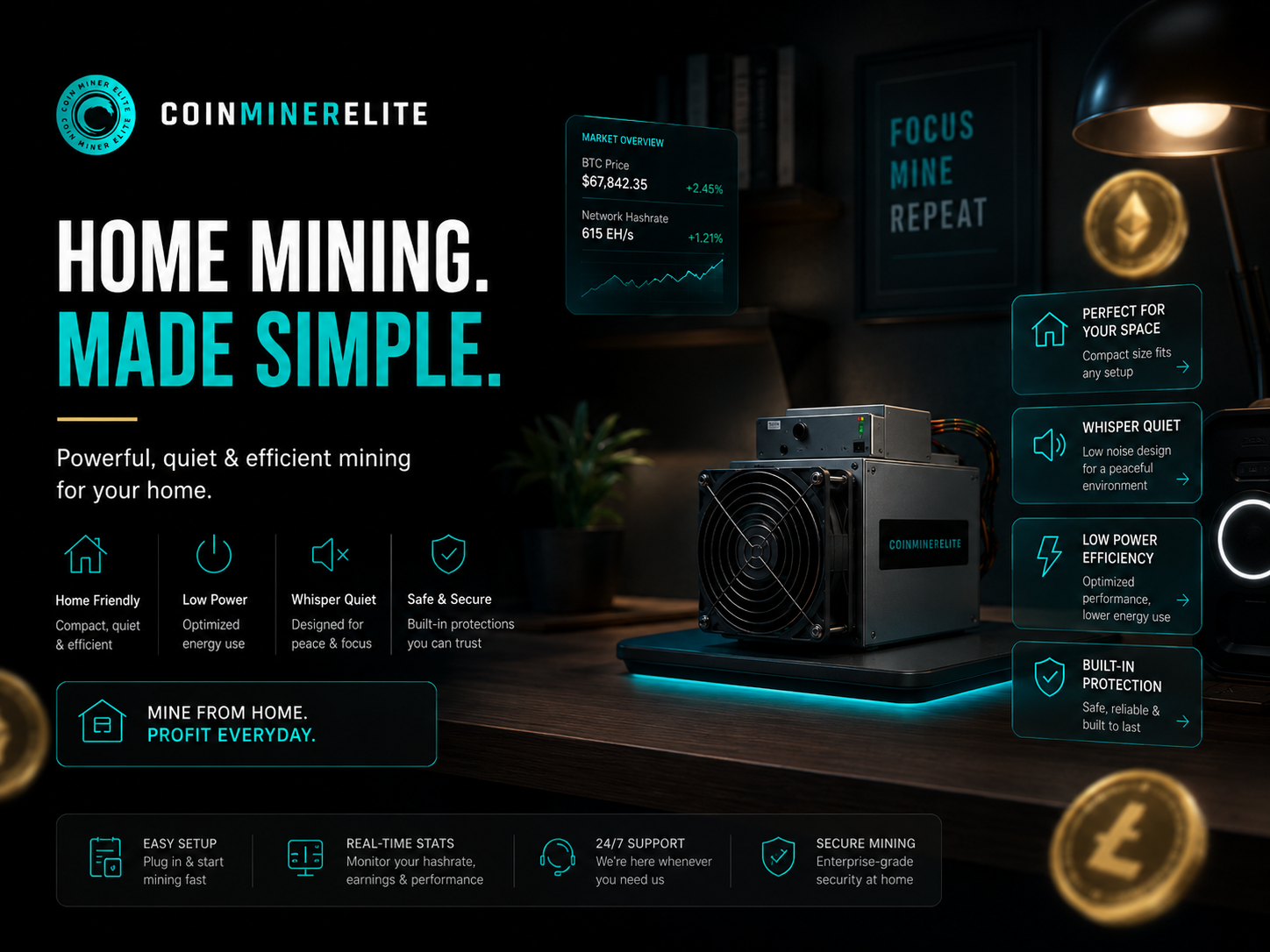
Home Mining Hardware for Compact, Practical and Efficient Setups
Home mining is less about maximum scale and more about smart fit. The right home miner should align with your power availability, your tolerance for noise and heat, and your goal—whether that is learning, building a compact mining setup or running a reliable unit over time. This page focuses on what makes a miner realistic for a home environment.
Ideal if you want to mine from home without jumping straight into industrial-grade hardware.
Focus
Noise, heat, power
Home success depends on environment management as much as on raw performance.
Next step
Check your room
Think about ventilation, electricity and uptime before ordering a machine.
01
Home mining starts with the environment
A good home miner is not just a miner with a lower price. It is a machine that fits the environment where it will operate. That means thinking about room size, ventilation, cable routing, sound level and how heat will move through the space.
Many issues attributed to the miner are really setup issues. A thoughtful location, stable power and sufficient airflow can make the difference between a manageable home setup and an exhausting one.
Choose a room with stable temperature and airflow
Avoid placing a miner where heat will accumulate quickly
Leave enough space around intake and exhaust areas
02
Noise and heat are real buying criteria
Hashrate and efficiency matter, but home buyers often discover too late that sound and heat are just as important. Even compact miners are still specialized hardware, and different models vary significantly in how easy they are to live with.
That is why quieter or lower-power units can sometimes be the best “home mining” choice even if they are not the absolute strongest performers on paper.
Check whether the room can tolerate continuous fan noise
Consider whether you need a quieter model or separate room
Treat heat output as an ongoing operating factor, not a minor detail
03
Power planning reduces surprises
A miner may be physically compact but still demand more power than a casual buyer expects. Before ordering, confirm what your available circuit, plug type and power capacity can handle. This is especially important if you plan to run more than one unit over time.
Simple planning up front avoids overloaded circuits, unstable operation and unnecessary troubleshooting after delivery.
Verify voltage and plug compatibility
Know the miner’s wattage and startup behavior
If in doubt, ask support before placing the order
04
Home mining is a great way to learn
For many buyers, home mining is the best entry point because it makes the full process visible. You learn wallet setup, pool configuration, monitoring, maintenance and profitability management in a smaller and more controllable environment.
That experience becomes valuable if you later scale into larger rigs or more advanced categories. Starting small is not a weakness; it is often a smarter path to long-term confidence.
Great for learning the full mining workflow
Helpful for understanding real electricity and uptime patterns
A good test bed before scaling further
05
Choose your next step based on your goal
If your goal is education and experimentation, a smaller and more manageable miner is usually the right move. If your goal is consistent long-term output from a dedicated room, you may be able to consider stronger home-compatible units with more planning.
The best home-mining decision is the one that matches your actual lifestyle and constraints—not the one that looks the biggest on a spec sheet.
Learning first → prioritize simplicity
Long-term home production → prioritize efficiency and reliability
Use these quick answers to remove uncertainty before you compare models, estimate ROI or proceed to checkout.
Can I mine crypto at home?
Yes. Many buyers start with home mining, but success depends on planning for power, heat, noise and airflow. Choosing a home-suitable model is more important than choosing the biggest machine available.
Is home mining profitable?
It can be, but profitability depends heavily on electricity price, machine efficiency, uptime and the coin you are mining. That is why you should always test your assumptions with the ROI calculator first.
What makes a miner home-friendly?
A home-friendly miner is typically more manageable in size, power draw and noise profile. It should fit your environment without creating unrealistic cooling or electrical demands.
Should I start with one miner or more than one?
Most home buyers should start with one unit. That makes it easier to learn the setup, understand running costs and identify whether the environment is suitable before expanding.
Do I need special ventilation?
Not always, but you do need to think about how hot air leaves the room and how fresh air reaches the miner. Even smaller setups benefit from basic ventilation planning.
What if I am unsure whether my home setup is suitable?
That is exactly when pre-sale support is most useful. Share your space, power and goals and use that information to narrow down the most realistic options.
Ready to compare?
Choose the right miner with confidence.
Compare specs, estimate ROI and contact us if you need help selecting the right model before checkout.