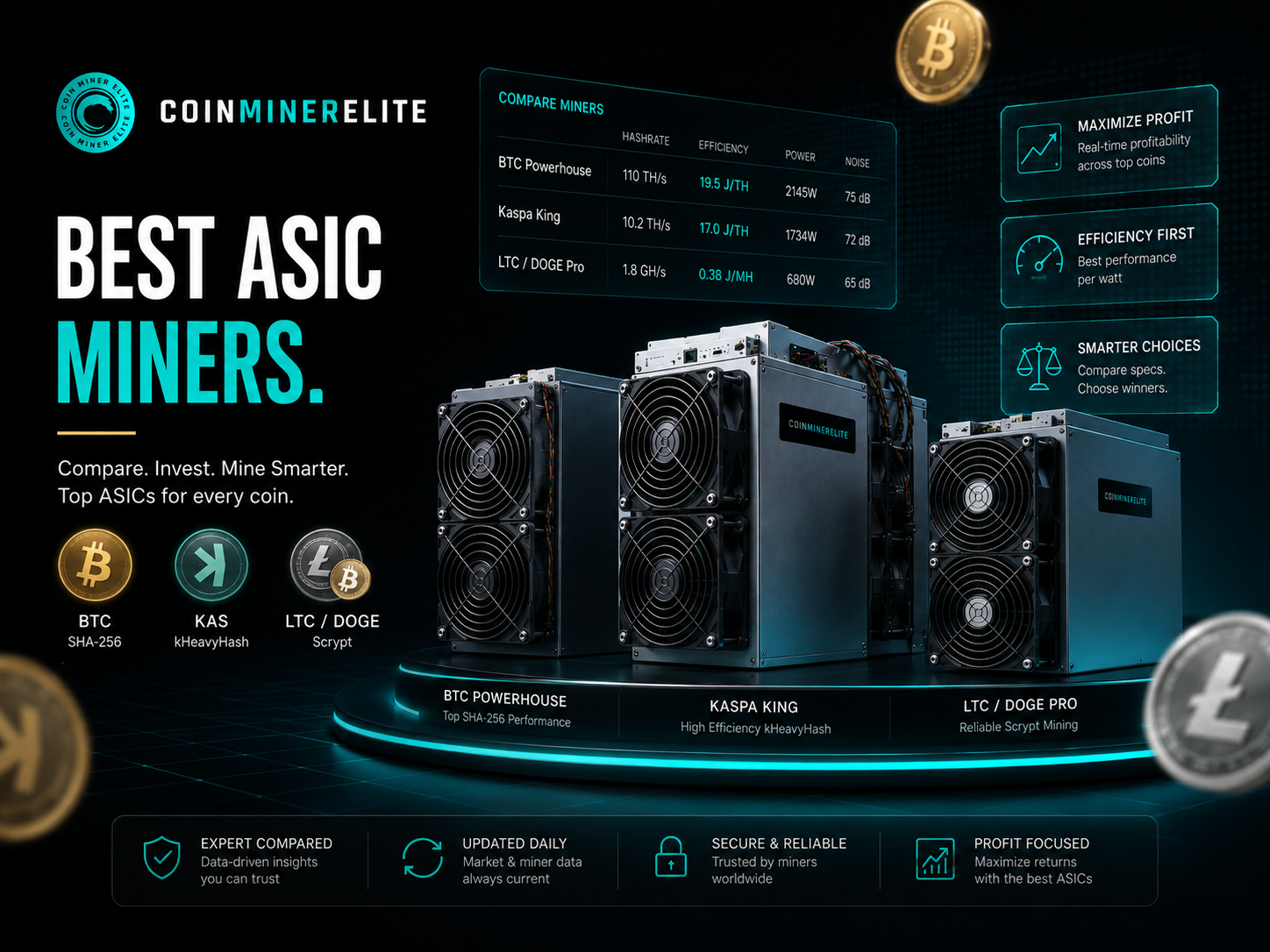
Best ASIC Miners for Bitcoin, Kaspa, Litecoin, Dogecoin and More
Choosing the best ASIC miner is not about chasing the loudest headline or the largest hashrate. The right miner is the one that matches your target coin, your power cost, your physical setup and your long-term mining strategy. This guide helps you compare major mining categories and build a shortlist with confidence before you buy.
A strong starting point if you want to compare categories before choosing a specific miner.
Focus
Efficiency first
Hashrate matters, but power draw, noise and cooling matter just as much.
Next step
Shortlist 2–4 models
Use this guide together with the compare page and ROI calculator.
01
Start with the coin, not the machine
A miner only makes sense when it matches the algorithm you want to mine. Bitcoin requires SHA-256 hardware, Litecoin and Dogecoin require Scrypt ASICs, Kaspa needs kHeavyHash-compatible hardware and other altcoins may require a completely different miner class. When buyers start with a machine instead of the coin, they often end up comparing products that should never have been in the same shortlist.
By starting with the coin or algorithm, you immediately narrow the field to relevant hardware, more realistic ROI assumptions and a more focused buying decision. That is the fastest way to avoid a mismatch purchase.
BTC → SHA-256 ASIC miners
LTC / DOGE → Scrypt ASIC miners
KAS → kHeavyHash ASIC miners
Altcoin categories may require niche or lower-volume hardware
02
Compare efficiency before chasing maximum hashrate
Hashrate is the headline metric, but efficiency is what often determines whether a miner fits your setup. Two miners can look similar on paper while delivering very different power consumption, cooling requirements and monthly running costs.
For most buyers, the best machine is the one that gives strong output while still making sense in their environment. A highly efficient unit can outperform a bigger, louder machine once electricity cost and operational constraints are included in the comparison.
Review power draw alongside hashrate
Look at efficiency metrics such as J/TH or the category equivalent
Consider noise, airflow and physical footprint before you buy
03
Match the miner to the environment
Some miners are better suited for learning, office, garage or home-lab environments. Others are clearly designed for industrial or semi-industrial setups with stronger power availability, dedicated ventilation and more tolerance for noise.
This environmental fit is one of the most overlooked parts of the buying process. A “best miner” list only becomes useful when you also ask where the unit will run, how it will be cooled and who will manage the setup day to day.
Home / quiet space → compact or lower-power units
Dedicated room / workshop → more flexibility for larger units
Industrial environment → hydro-cooled or very high-output systems may become realistic
04
Use ROI as a decision tool, not a promise
Mining returns change with electricity cost, network difficulty, coin price, uptime and pool performance. That means no honest guide should present ROI as a fixed promise. The best use of ROI is to compare scenarios and identify which machines continue to make sense under more conservative assumptions.
If a miner only looks attractive under unrealistically low electricity prices, it may not fit your real setup. That is why CoinMinerElite positions ROI as a planning tool that helps you compare opportunities more intelligently rather than a guarantee of future earnings.
Run optimistic and conservative scenarios
Factor in your local kWh rate
Check whether lower-noise or lower-power units produce better risk-adjusted outcomes
05
Build a shortlist, then validate with support
A smart buying process usually ends with a shortlist of two to four models. From there, you can compare inventory, delivery timing, payment preferences, setup goals and support needs. This final step often turns a broad hardware search into a confident order.
If you are unsure between categories or specific models, pre-sale support is useful because the right answer often depends on your intended use case rather than a universal ranking.
Shortlist by algorithm
Validate by environment and electricity cost
Confirm setup questions before checkout
Use Compare + ROI + Support together for the final decision
Use these quick answers to remove uncertainty before you compare models, estimate ROI or proceed to checkout.
What is the best ASIC miner overall?
There is no single best ASIC miner for every buyer. The right choice depends on the coin you want to mine, your electricity cost, your power setup, your tolerance for noise and your budget. A home buyer and a high-output farm operator should not be choosing from the same shortlist.
Should I choose the miner with the highest hashrate?
Not automatically. A high-hashrate machine can look impressive, but once power draw, cooling and electricity cost are included, a smaller or more efficient model may be the better choice for your situation.
What should beginners compare first?
Beginners should start with algorithm compatibility, power requirements, physical environment and ease of setup. Once those points make sense, then compare efficiency, price and estimated profitability.
Can I compare different miner categories on CoinMinerElite?
Yes. Use the Compare page to review multiple miners side by side, then move to the ROI calculator to pressure-test the shortlist with your electricity assumptions.
Are home and industrial miners the same thing?
No. Some miners are much more practical for home or compact setups, while others are clearly intended for larger dedicated environments. Always match the miner to the place where it will run.
What is the safest next step after reading this page?
Build a shortlist of relevant models, then review their category page, compare them side by side and contact support if you want a second opinion before you order.
Ready to compare?
Choose the right miner with confidence.
Compare specs, estimate ROI and contact us if you need help selecting the right model before checkout.