ASIC Miner ROI: Estimate Mining Profitability Before You Buy
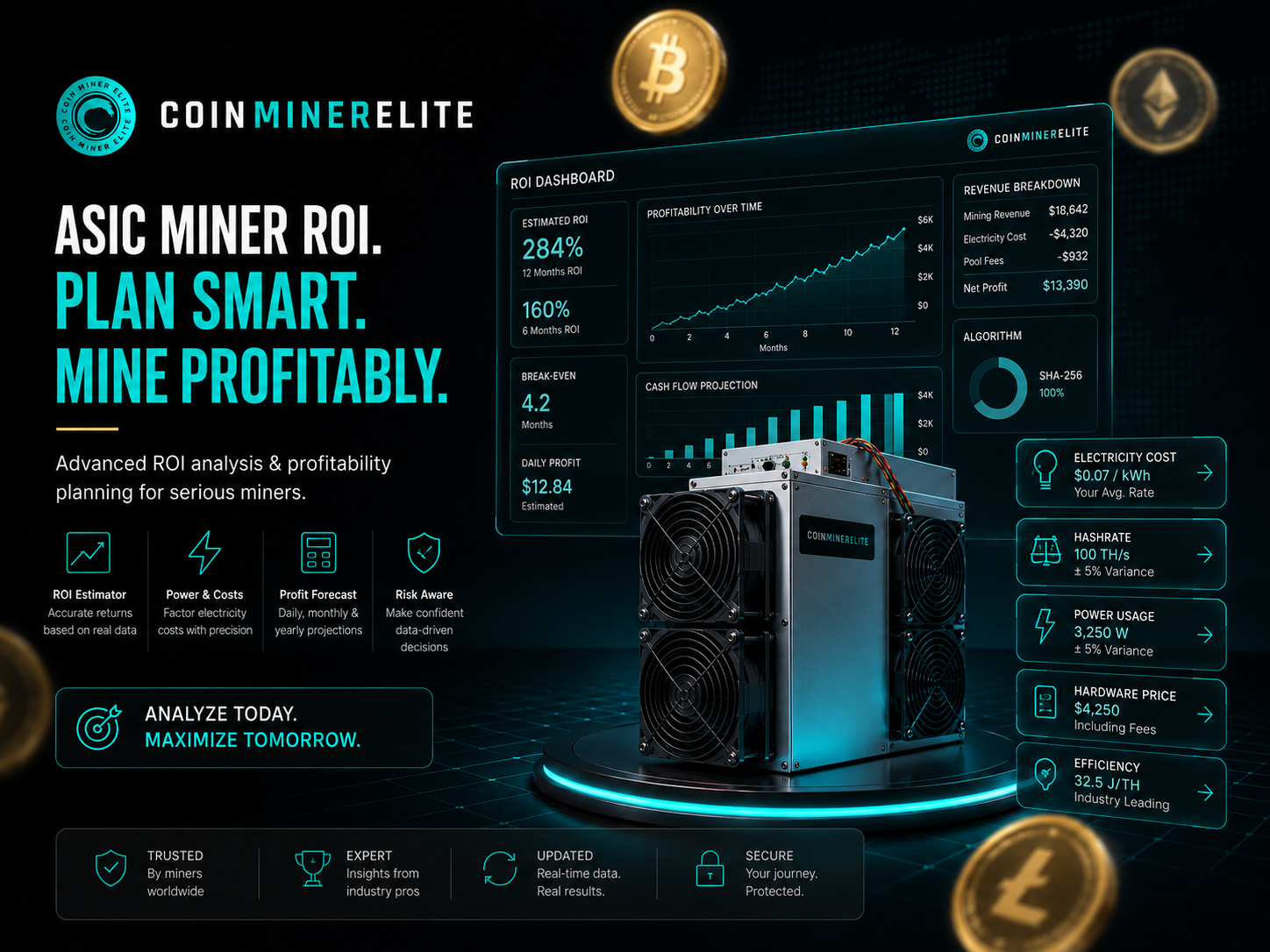
Mining profitability is one of the biggest reasons buyers hesitate, and that is understandable. Real ROI depends on more than a product page headline. Electricity cost, network conditions, coin price, uptime and machine efficiency all influence the result. This page helps you use ROI the right way: as a planning framework for better decisions.
Ideal if you want to judge profitability more realistically before you buy hardware.
Focus
Real assumptions
ROI improves when it is based on your electricity, your setup and a realistic time horizon.
Next step
Test scenarios
Run at least two or three scenarios before deciding on a miner.
01
ROI is a tool, not a promise
One of the biggest mistakes in mining is treating ROI as a guarantee. In reality, profitability shifts with electricity cost, network difficulty, coin price, pool fees and uptime. That means ROI should be used to compare possibilities—not to assume certainty.
The value of ROI is that it helps you make better decisions before purchase, especially when several miners look attractive at first glance.
Use ROI for comparison, not prediction certainty
Review multiple assumptions before trusting a result
Stay realistic about volatility and operational variance
02
Electricity cost changes everything
Two buyers can get completely different results from the same machine because their electricity cost is different. This is why electricity is one of the most important inputs in any mining calculator.
Without your real kWh rate, ROI is not decision-grade information. It is just a rough generic estimate.
Use your actual local kWh rate
Compare optimistic and conservative energy assumptions
Re-check profitability if your energy cost changes
03
Efficiency matters as much as the purchase price
A miner with a higher upfront cost can still be the stronger long-term option if it is substantially more efficient. Conversely, a cheaper machine may look attractive at checkout but cost more over time because it burns too much power.
That is why efficiency should always be considered alongside price—not after the fact.
Compare price and efficiency together
Use power draw to estimate monthly cost impact
Think in terms of total operating reality, not just the upfront purchase
04
ROI works best with a shortlist
The ROI calculator becomes especially useful once you already have a shortlist of possible machines. At that point, you can run the same assumptions across multiple miners and see which ones hold up better.
This is much more useful than trying to calculate the entire market at once.
Shortlist 2–4 miners first
Run the same electricity assumption across each one
Compare which model stays strongest under conservative assumptions
05
Combine ROI with product fit
The most profitable miner on paper is still the wrong purchase if you cannot power it, cool it or manage it effectively. ROI should support the buying decision, but never replace setup reality.
The strongest decisions combine product fit, environment fit and conservative profitability planning in one process.
Use ROI with category pages and compare tools
Validate environment and operating conditions
Ask support if numbers look strong but the setup still feels unclear
Use these quick answers to remove uncertainty before you compare models, estimate ROI or proceed to checkout.
Is ASIC mining ROI predictable?
Not with certainty. ROI can change as network difficulty, electricity rates, uptime and coin prices change. That is why ROI should be used as a planning and comparison tool, not as a promise.
What is the most important ROI input?
Electricity cost is often the single most important input, especially when comparing multiple machines. Efficiency then determines how heavily those energy costs affect the result.
Should I buy only based on ROI?
No. Also consider power requirements, noise, heat, setup complexity, delivery expectations and support. A machine must fit your real environment as well as your modelled profitability.
How many ROI scenarios should I run?
At least two or three. A realistic process includes a conservative case, a moderate case and, if useful, an optimistic case.
Is a higher-efficiency miner usually worth more?
Often yes, especially over time. A more efficient unit can produce better long-term economics even if the initial price is higher.
What is the best next step after reading this page?
Take your shortlist into the ROI calculator, then return to the compare page and product pages with the results in mind.
Ready to compare?
Choose the right miner with confidence.
Compare specs, estimate ROI and contact us if you need help selecting the right model before checkout.